18+ only. Crypto gambling involves risk - never wager more than you can afford to lose. Some links may be affiliate links; rankings stay independent. Gamble responsibly.
A long-running dice site that documents native ZEC play. Licence check resolved: the Anjouan number claimed in its own terms (ALSI-202509013-FI1, Zentari Limitada) now appears in the official register (read 2026-11-20: valid, expiry 2027-09-15, domains duckdice.io and tower.bet) - it was absent when we checked on 2026-10-24, so the entry appeared between those reads. Watch-grade caveat stays: KYC can be requested at any time and the payout path is undocumented.
Risk-based KYCProvably fair
Progressive jackpot bonus, sniper race, reload offers and occasional no-deposit campaignsVaries per promotion; 1x wagering of eve…
The cleanest no-KYC XMR dice site: on-chain provably fair, payouts in minutes, operator answers complaints - anonymous and unlicensed, so keep it to small rolls.
An accountless XMR coinflip/dice site with a public on-chain bankroll and long domain history - still a one-person custodial operation: bet small, withdraw fast.
Pure accountless XMR dice with a Tor mirror and on-chain fairness - currently behind a Cloudflare challenge with zero track record; one bet at a time, never more.
A working XMR over/under dice game with documented provable fairness - but the operator's own page admits a 10-33% edge; mathematically honest, commercially predatory.
Dice was the first crypto casino game and it remains the most verifiable: a roll, a payout table, and a house edge that operators publish in writing. Documented edges around 1% are standard for dice originals [1][3] - compare that with 3-6% typical slot edges, and you see why dice became the backbone of crypto gambling.
The game is simple enough to verify end to end. That is the point: a provably fair dice roll publishes its server seed (hashed before play), your client seed, and a nonce. You can recompute the roll yourself, or paste the values into our verifier tool and let it do the math [4].
What varies between dice sites
Three things. Edge and payout table: edges cluster around 1% but the max multiplier and win-chance curves differ. Limits: minimum bets from fractions of a cent, maximums from single bets to per-day caps - the limits decide whether you can actually play your strategy. Model: accountless payout-address sites versus full accounts. All three are documented per operator with sources.
Verification as a habit
Our verifier tool supports the schemes documented by operators. The habit that matters: verify a handful of rolls per session, not just once. If the math stops matching the published scheme, stop playing and document it - that is exactly the evidence the complaints sections collect.
Bankroll notes specific to dice
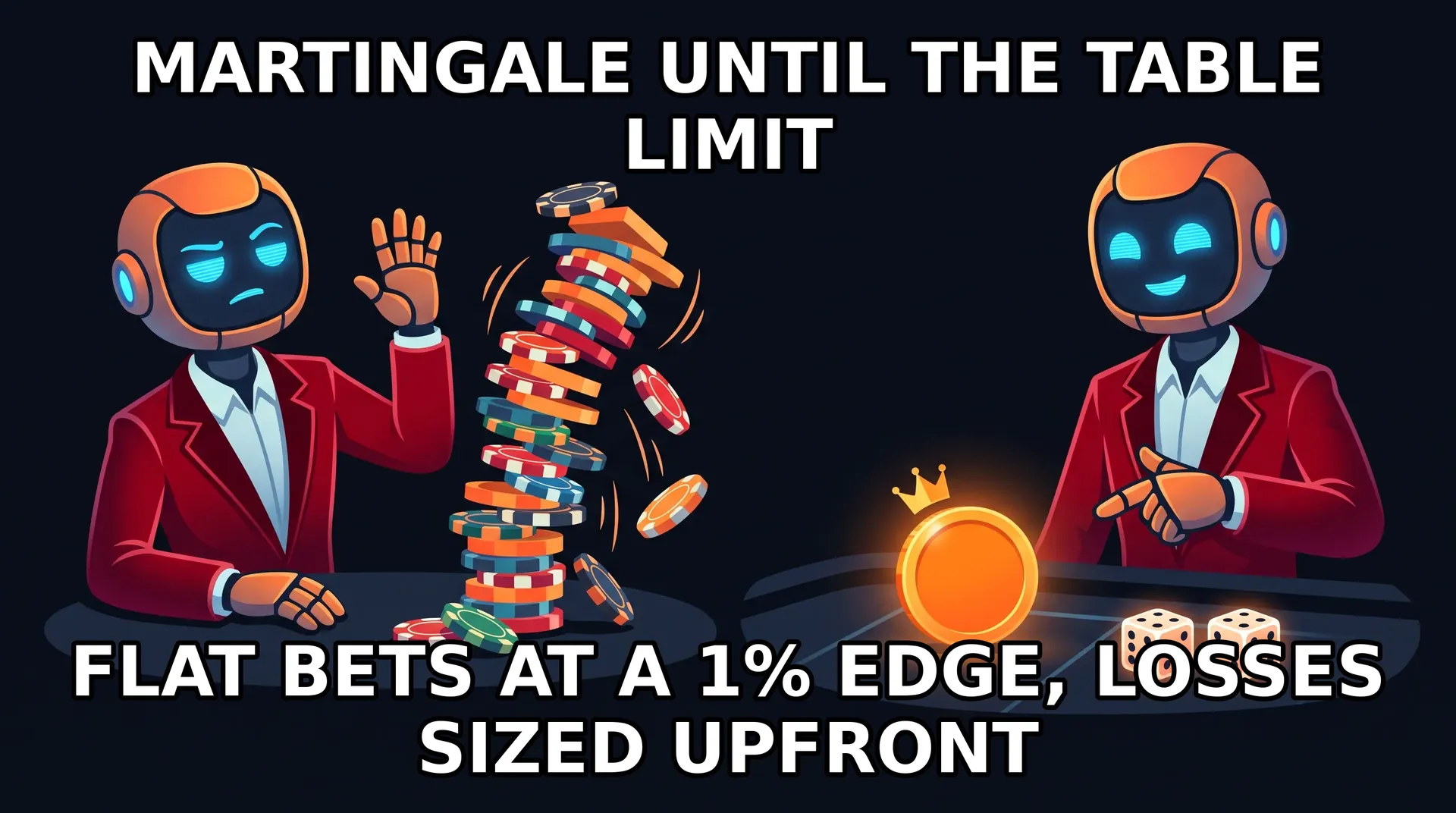
Dice rewards session discipline because the edge is small and the variance is controllable: you choose the win chance. High win chance means small, frequent results; low win chance means long droughts between wins. Either way the expected cost per bet is the edge times your stake - our house-edge calculator turns a session plan into an expected cost per hour.
Documented edges on dice originals cluster around 1% - among the lowest in casino gaming. Each review lists the operator's documented edge.
How do I verify a dice roll myself?
Provably fair dice publish server seed, client seed and nonce. The verifier tool recomputes the roll from those values - math, not trust.
Is dice mathematically better than slots?
Usually yes on edge: ~1% documented dice edges compare with 3-6% typical slot edges. Your volatility tolerance matters more than the edge alone.
Do dice sites need an account?
The accountless model is native to dice: your payout address doubles as your login. Larger platforms offer full accounts with the same games.
Can I set loss limits on dice sites?
Where documented, yes - the player-protection section of each review lists what exists. It is one of the checks we record.
What is a fair roll probability at 2x payout?
At a documented 1% edge, a 2x payout roll wins with about 49.5% probability. The published edge and payout table should always match - that is what verification checks.